What Your Rice Purity Score Really Means (Full Breakdown)
What Your Rice Purity Score Really Means (Full Breakdown)
If you’ve just finished the Rice Purity Test and you’re staring at a number wondering what it actually says about you, you’re not alone. This is one of the most searched questions related to the test, and the honest answer is simpler — and more reassuring — than most people expect.
This guide breaks the topic down in plain language: how the number is calculated, why it isn’t a judgment of any kind, what each general range tends to represent, the everyday factors that actually move the needle, and the most common ways people misread their own result. By the end, you should have a clear, grounded sense of what your score does and doesn’t say about you.
Understanding Your Score
Your Rice Purity Test score is a number between 0 and 100 that reflects how many items on a fixed checklist of common life experiences apply to you. You start at 100 points, and each item you check off — meaning something you’ve genuinely experienced — lowers your total by a small, equal amount. Once you’ve gone through the full list, whatever number remains is your final score.
That’s the entire mechanism. There’s no hidden weighting, no bonus points, and no penalty beyond the simple subtraction built into the format. It’s the same basic logic as a checklist quiz in any magazine or app: more boxes checked, lower the number; fewer boxes checked, higher the number.
People sometimes assume the questions must be weighted differently — that a bigger life milestone subtracts more points than a smaller everyday one. In the classic format, that isn’t the case: every item is worth the same fixed amount regardless of how significant it might feel subjectively. That’s a deliberate simplicity, not an oversight. It keeps the scoring transparent and easy to follow in real time, which is part of why live-updating versions of the quiz, like the one on this site, can show your score shifting instantly with every single answer.
Where people get tripped up is in what they assume the number represents beyond that. A score isn’t a verdict on your personality, your morals, or your life choices — it’s a literal count of how many predefined statements happen to describe things you’ve done. Two people with wildly different lives, values, and personalities can land on the exact same score purely by coincidence, simply because the list only captures a narrow slice of experience.
It also helps to think about what the checklist doesn’t measure. It says nothing about your relationships with family, your work ethic, your creativity, your sense of humor, or the hundreds of smaller, unlisted moments that actually shape a life. A perfect stranger could hand you a completely different set of one hundred statements and you’d likely land on a completely different number — not because you changed, but because the yardstick changed. That’s the clearest proof that the score describes the checklist, not the person taking it.
Many people find it useful to mentally separate the word “score” from the word “grade.” A grade implies effort, correctness, and comparison against a standard. A score here is closer to a tally on a scoreboard in a casual game — it exists to give the moment a bit of structure and a number to talk about, not to rank anyone against anyone else.
Why the Score Isn’t a Judgment
It helps to remember where this test came from. It wasn’t designed by researchers trying to measure something meaningful about human development — it was written by college students in the 1920s as a fun way to break the ice during orientation week. The goal was conversation and laughter, not evaluation.
Because of that origin, the test was never built with any scoring theory behind it. There’s no psychological framework saying that a 45 is “healthier” than a 75, or that a 20 indicates anything about a person’s judgment or character. The number is descriptive, not evaluative — it tells you how many items apply, and nothing more.
This distinction matters because a lot of the anxiety people feel about their score comes from treating it like a grade. Once you separate “how many boxes I checked” from “how good or successful I am,” the whole exercise becomes a lot lighter and more enjoyable — which is exactly how it was meant to be taken in the first place.
It’s also worth remembering that the checklist was assembled by a group of students almost a century ago, reflecting whatever experiences felt notable to that particular group at that particular time. It wasn’t peer-reviewed, tested against any population, or revised by researchers. Treating a decades-old, informally written list as an authority on anyone’s life story asks far more of it than it was ever built to deliver. The far more accurate way to think about it is as a shared cultural artifact — something people recognize and enjoy precisely because it’s familiar and casual, not because it’s rigorous.
Score Range Breakdown (0–100)
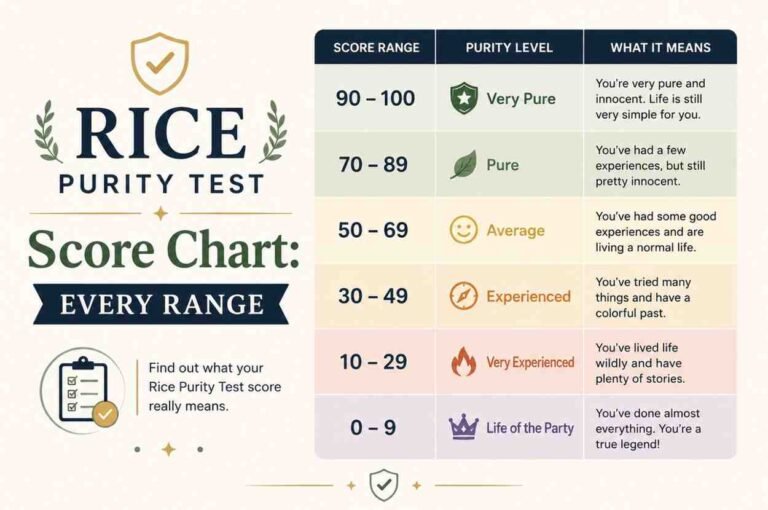
To make results a little easier to talk about, most versions of the test group scores into five broad bands. These labels are informal and meant purely for color — they’re not scientific categories, so don’t read too much into exactly which side of a boundary you land on.
| Score Range | Common Label | What It Typically Reflects |
|---|---|---|
| 90–100 | Very Reserved | Very few listed experiences have happened yet — a lot of firsts still ahead. |
| 70–89 | Mildly Adventurous | A modest number of experiences, with a generally cautious overall pace. |
| 40–69 | Well-Rounded | A healthy mix of everyday and bigger milestones — the most common range. |
| 20–39 | Very Experienced | Most listed items apply, suggesting an eventful stretch of years. |
| 0–19 | Extremely Experienced | Nearly everything on the checklist applies to your life so far. |
Notice how wide the “Well-Rounded” band is — it covers roughly a third of the entire scale. That’s intentional in how the checklist was originally structured: most people, regardless of background, tend to land somewhere in the middle simply because life experiences accumulate gradually rather than all at once.
It’s also worth noticing that the boundaries between bands are somewhat arbitrary. A score of 69 and a score of 71 sit in different labeled categories on paper, but in practice they represent almost identical amounts of experience — just two checklist items apart. If your result happens to land right at one of these edges, it’s more useful to think of yourself as being “around the low 70s” or “around the high 60s” than to fixate on which exact label technically applies. The bands exist to make results easier to talk about in conversation, not to draw a hard line between meaningfully different groups of people.
Some people also like to track how their band shifts over time rather than focusing on the exact number. Moving from “Very Reserved” toward “Well-Rounded” over the course of a few years is a natural reflection of simply living more of life — new jobs, new relationships, new places, new routines. There’s no need to rush that progression, and there’s equally no need to feel behind if it’s moving more slowly than a friend’s.
What Influences Your Number
A long list of ordinary factors shapes where you land on the scale, and almost none of them have anything to do with character or intelligence. Common influences include:
- Age — more time generally means more opportunities to check off items, though this varies enormously person to person.
- Living situation — moving away from home, living independently, or staying close to family all shape which experiences come up naturally.
- Social environment — a large, active friend group tends to create more opportunities for shared experiences than a smaller, quieter one.
- Personal comfort level — some people are simply more inclined toward trying new things, regardless of age or circumstance.
- Culture and upbringing — different backgrounds place different values on independence, dating, and social milestones.
- Timing and chance — plenty of experiences on any checklist happen simply because the opportunity presented itself at the right moment.
None of these factors are things a person controls entirely, which is exactly why comparing scores across very different life situations rarely tells you anything useful.
Consider two hypothetical people the same age: one grew up in a large city with an extended social circle and moved out for university at eighteen, while the other grew up in a smaller town, stayed close to family, and started working locally right after school. Neither path is better or worse, yet the two are likely to check off noticeably different sets of items purely because their day-to-day environments offered different opportunities. The checklist can’t account for context like this — it simply counts yes-or-no answers — which is exactly why the resulting number should be read with that context in mind rather than taken as a standalone fact about either person.
Even within the same household, siblings can end up with different scores for reasons as simple as birth order, personality differences, or which friend groups they happened to fall into during school. None of that reflects anything meaningful about who they are as people — it’s simply how unevenly life experiences get distributed even among people who grew up under nearly identical circumstances.
Common Misreadings of a Score
A few interpretations come up again and again, and all of them stretch the test well beyond what it was ever designed to do.
“A high score means someone is sheltered.” Not necessarily — it might simply mean someone has been focused on school, work, or a specific goal, or that their circle of friends hasn’t led them toward certain experiences yet.
“A low score means someone is reckless.” Also not a safe conclusion — a lower score often just reflects an active social life, more independence, or simply more years lived, none of which implies poor judgment.
“The score predicts anything about the future.” It doesn’t. It’s a snapshot of the past up to the moment you took the test, not a forecast of who you’ll become.
“A big drop between two attempts means something went wrong.” It doesn’t necessarily. A large shift between one attempt and a later one usually just means a lot happened in between — a move, a new relationship, a new job, a big trip — the ordinary texture of getting older, not a sign of anything concerning.
“Comparing scores in a group ranks everyone.” Only if you choose to treat it that way. The test itself doesn’t rank anyone; any competitive framing gets added afterward by the people taking it, and it’s entirely optional to skip that part altogether and just enjoy comparing notes casually.
The healthiest way to read your result is the way it was originally intended: as a quick, fun tally you can laugh about with friends, not a statement about who you are.
One more misreading worth naming directly: some people assume that because the checklist is old, or because it’s widely shared, it must have been validated somewhere along the way — the same way a popular recipe or a viral trend can feel more “true” just because a lot of people engage with it. Popularity and accuracy are unrelated, though. The test has spread because it’s fun and easy to share, not because anyone has demonstrated that it measures something real. Keeping that distinction in mind is the single best way to enjoy the test without overanalyzing the result afterward.
If you find yourself dwelling on your score longer than the few minutes it took to get it, it can help to reframe the whole exercise: rather than asking “what does this number say about me,” try asking “which of these experiences do I actually want more of, and which ones don’t matter to me at all.” That question is far more useful, and it’s one the checklist can’t answer for you — only you can.
The Bottom Line
Your Rice Purity Test score is exactly what it appears to be: a running count of how many items on a specific, decades-old checklist happen to match your life so far. It’s a genuinely fun thing to look at, share, and laugh about with friends — but it was never designed to carry any deeper meaning, and treating it that way is the surest way to take the fun out of it.
If you’re still curious about your own number, the best next step is simply to take the test itself and see where you land, keeping in mind everything above about how loosely the result should be read. And if you’ve already taken it, consider this your permission slip to stop overthinking the exact digits and just enjoy the number for what it is: a small, harmless snapshot of one particular checklist on one particular day.